
NeuraPoints for Orchestrating Thinking Patterns
From Google Maps to Mapping the Cognitive Code

The Cartography of Cognition
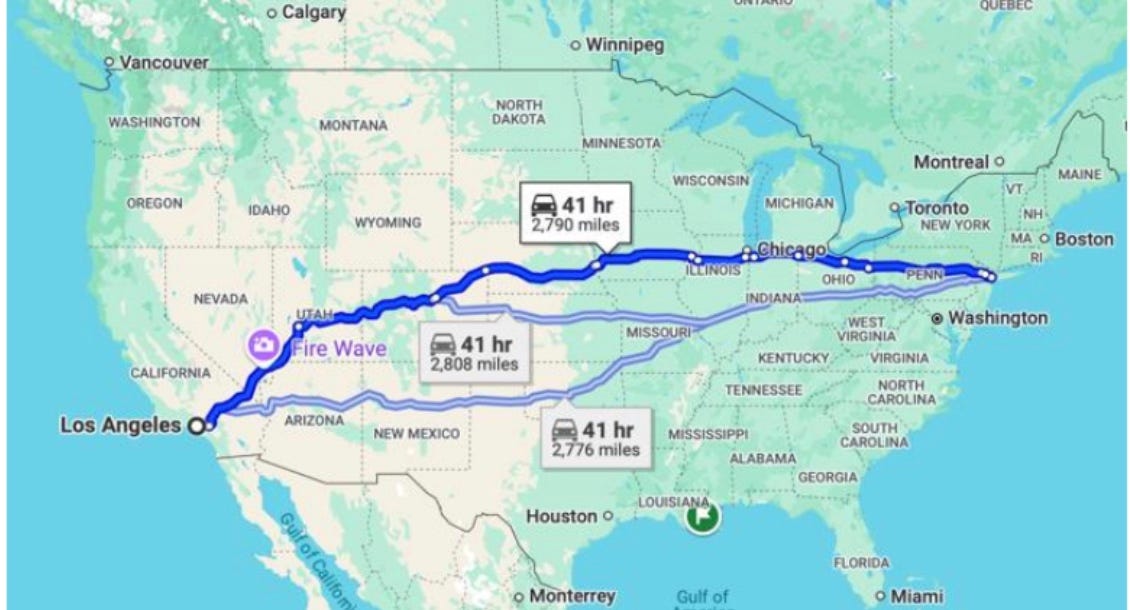
Before going into depth about NeuraPoints, let’s explore the conceptual metaphor that grounds both the simplicity and utility of this cognitive code: mapping or the science of cartography. Many of us now use Google Maps and other programs to navigate by road, air and sea. AI enhanced, we access information via the live map itself, zooming in on addresses, accessing information from the internet, zooming out to see the big picture, requesting direct and alternative routes, while being rerouted in real time. Notice the simplicity and clarity of Google Maps and other navigation programs: simple points, links showing alternative patterns and destinations while offering a big picture map of the territory. Iterations. Fractals. As Einstein is purported to have said: “Make everything as simple as possible, but not simpler.” If there were too many icons and an overly complex “code” for reading a map we would lose the effectiveness and efficiency of this basic design that leads to complex forms.
Simply, we could not see the forest holistically as an ecosystem or see the deep connections to the trees and surrounding context with specificity.
Yes, maps are not the whole territory: each step and turn is taken on our own, just as we travel through our lives with our own evolving cumulative network of information bits, the authenticated factual record, the false-fact propaganda and faulty science, our interpretations, and our generative knowledge.
Google Maps is the lastest technology in the long history of cartography as human beings have visually mapped everything from the sky, trade routes, subway systems and creating even new maps of previously unknown territories, such as the mapping of our own brains.
Cartography has evolved with the human mind and with new technologies—from drawings on cave walls to present high tech imagery. Google Maps is also a useful conceptual metaphor for the development and evolution of NeuraPoints. Both are based on cartography. Google Maps helps us simply access and traverse the physical landscape toward certain destinations. NeuraPoints-- using similar graphic primitives such as points, links, and processes-as- patterns—helps us connect point to point, and pattern to pattern. We landscape our thinking, learning, and decision making. But unlike Google Maps that display tangible points on a map, NeuraPoints guide us to explore and analyze the territories of our mind which have no boundaries.
NeuraPoints and the Neurosciences
Learners of all ages may use NeuraPoints to think independently and collaboratively across in-person and virtual school communities and workplaces. From novice to expert, thinking-learners interpret and connect points of information together with color-coded visual links and integrate cognitive patterns together. We are able to generate a visual mapping of our own mental, emotional schemata and “frames” of reference. NeuraPoints represents what a leading educator and neuroscience expert Pat Wolfe offered about the value of mapping cognitive processes:
Neuroscientists tell us that the brain organizes information in networks and maps.What better way to teach students to think and organize and express their ideas than to use the very same method that the brain uses. (Pat Wolfe, 2004)
Wolfe is drawing from studies showing that our brains are always actively translating sensory information into nodes that run along neural pathways, re-cognizing, discarding and sorting these nodes into neural networks, then distributing these bits in patterns across specialized regions. NeuraPoints mirrors the same process for our more conscious minds. Individual points (nodes) are linked together (neural pathways) and are retained in cognitive patterns (neural networks), thus presenting a map of how the patterns connect as a generative system.
The cognitive process patterns that define NeuraPoints are, in every moment, being elegantly orchestrated together in the human mind and brain as fundamental for thinking, learning, and human intelligence as we interpret the world around us. As described below, these process patterns are also occurring unconsciously, physiologically in the human brain.
These five specific cognitive processes and the drawing together of congruent visual patterns into a colorful cognitive code have evolved from more philosophical development centuries ago and maybe more formally beginning with John Dewey’s classic book published in 1919: How do we Think? As the cognitive neurosciences, technology, and nascent artificial intelligence fields grew, I began to realize and question my own extensive work in the 1980s and 90s in the field of visual tools for thinking. Something essential was missing. When I practiced and implemented a range of visual tools and then created the Thinking Maps® model in the mid-1980s, I sensed that I did not capture and visually underrepresented the rich interplay, definitions and connectivity of fundamental cognitive processes and patterns.
All the successful visual thinking tools models— Mind Mapping® for creativity, Concept Mapping® for concept development, graphic organizers for structured content learning processes, and Thinking Maps® for isolating cognitive processes—are successful in their own ways. At the same time, the range and plethora of visual tools separated rather than united different types of thinking both by definition and by design. I became curious about how the mind and brain orchestrate the “forest and the trees”, or the details and big picture integration of thinking processes and visual tools. Around 2010, I began challenging myself with this question:
Could I draw together what I had learned into a more united, if not universal model,
that more closely represented the rich, unified, interconnected thinking patterns of
mind and brain in body?
And then, a breakthrough.
TO BE CONTINUED LATER THIS WEEK!